
5 Pilates Exercises to Improve Your Golf Swing
Most golfers try to fix their swing with more lessons, a new driver or another bucket of balls. But very often, the thing holding your swing back isn’t technique – it’s your body. Stiff hips, a locked-up upper back or a weak core will limit your swing no matter how good your coaching is. Here are five Pilates exercises I use with golfers to change that, plus two full sessions you can follow along with at home.
The short answer
- A powerful, repeatable swing needs mobility, stability, strength and control
- Pilates trains all four – especially trunk rotation, hip mobility and core control
- These five exercises take about 15 minutes and need only a mat
- If something hurts, stop – and get it assessed before you play through it
Why golfers and Pilates are a natural fit
I’ve worked with golfers for years, including with Scottish Golf, and the same pattern comes up again and again. Golf is a full-body, complex, asymmetrical movement: you rotate hard in one direction, thousands of times a season. The body adapts – and not always helpfully. One hip gets stiff, the upper back stops rotating, and the lower back ends up doing work it was never designed for.
Current research suggests the core muscles play a vital role in creating a powerful golf swing. Pilates focuses on exactly the areas golfers need: trunk rotation, spinal flexibility and stability. It’s no wonder some of the world’s top professionals have added Pilates to their routines.
The big idea is something called the “bottom-up” transfer of energy. Power in a good swing starts from the ground, travels up through your legs and hips, through a stable trunk and out into your arms and the club head. If any link in that chain is stiff or unstable, you leak power – and often compensate in ways that cause pain.
Before you start: move slowly, breathe steadily and stay within a comfortable range. These exercises shouldn’t cause pain. If you have a current injury, or pain in your back, hip or shoulder, have it assessed by a Chartered Physiotherapist first.
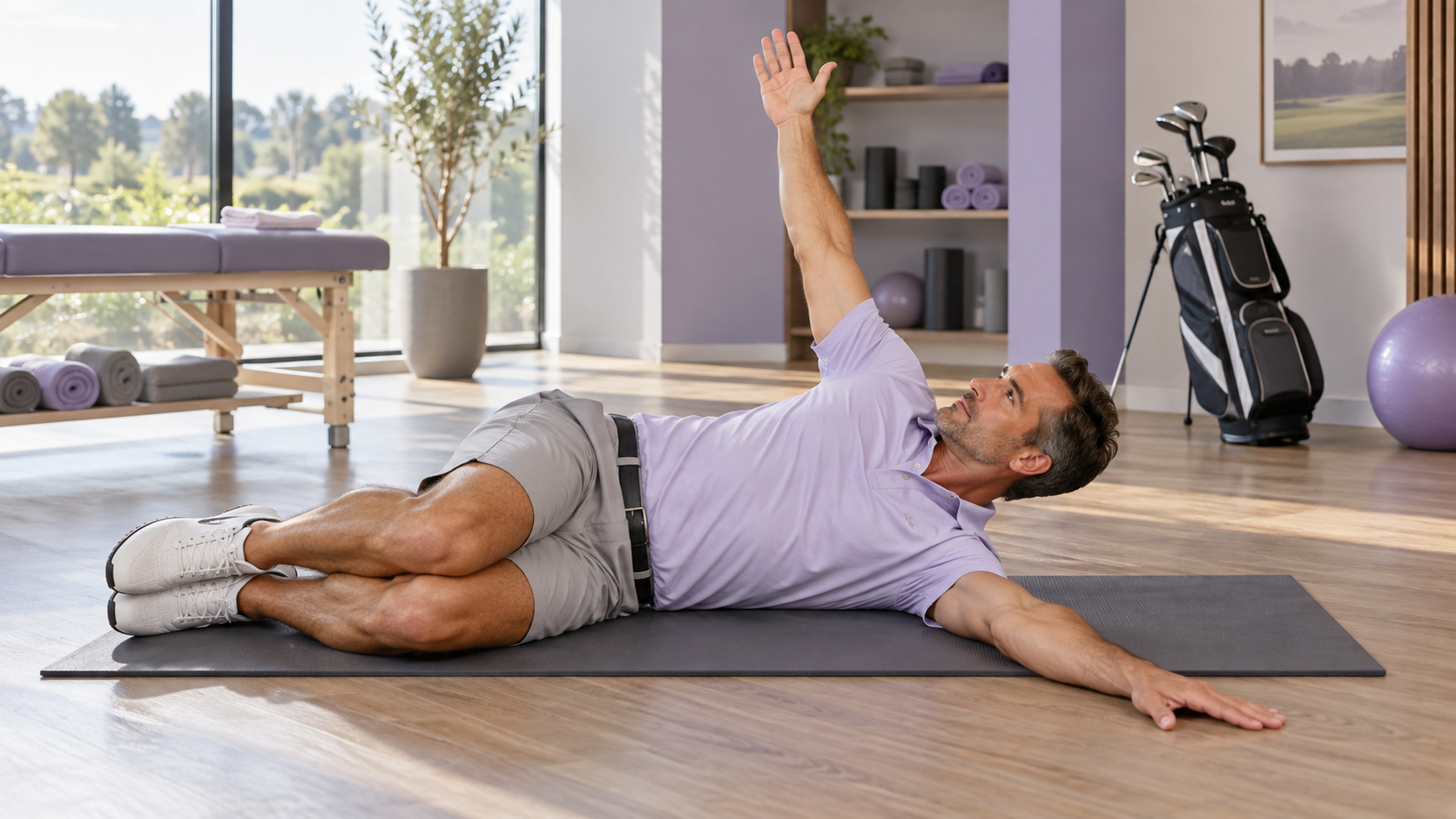
1. Open book (for upper-back rotation)
Why it helps your swing: your upper back (thoracic spine) should do much of the rotating in your backswing. When it’s stiff, your lower back and arms take over – a common cause of both lost distance and back pain.
- Lie on your side with your knees bent to 90 degrees and your arms straight out in front of you, palms together.
- Keeping your knees together and on the floor, lift your top arm up and over, opening your chest towards the ceiling. Follow your hand with your eyes.
- Rotate as far as is comfortable, breathe out, then slowly return.
Do: 8 slow reps each side. Common mistake: letting your knees lift apart – keep them stacked so the rotation comes from your upper back.
2. Glute bridge (for power from the ground)
Why it helps your swing: your glutes are your engine. Strong glutes help drive weight transfer and rotation through impact – and help protect your lower back.
- Lie on your back with your knees bent and feet flat, hip-width apart.
- Breathe out, gently draw your lower tummy in, and lift your hips until your body forms a straight line from shoulders to knees.
- Pause, then roll down slowly, one vertebra at a time.
Do: 10–12 reps. Make it harder: hold at the top and lift one foot slightly off the floor, keeping your hips level.
3. Bird dog (for trunk stability)
Why it helps your swing: a stable trunk lets you rotate powerfully without your posture collapsing. This exercise trains your core to resist unwanted movement – the key to a repeatable swing.
- Start on all fours, hands under shoulders and knees under hips, with a neutral spine.
- Slowly reach one arm forward and the opposite leg back, keeping your hips and shoulders level.
- Hold for a breath, return with control, and switch sides.
Do: 8 reps each side. Common mistake: lifting the leg too high and arching your back – think “long”, not “high”.
4. Side plank (for lateral core strength)
Why it helps your swing: the muscles along the side of your trunk and hips keep you stable as you shift your weight – helping you stay in posture and strike the ball more consistently.
- Lie on your side, propped on your forearm with your elbow under your shoulder and your knees bent.
- Lift your hips so your body forms a straight line from your head to your knees.
- Hold, breathing steadily, then lower with control.
Do: hold for 20–30 seconds, 2–3 times each side. Make it harder: straighten your legs and balance on your feet.
5. Clam (for hip control)
Why it helps your swing: the glute muscles on the side of your hip control your knee and pelvis as you load into your trail leg and rotate through. Weakness here often shows up as swaying or sliding in the swing.
- Lie on your side with your hips and knees bent and your feet together, head resting on your arm.
- Keeping your feet together and your pelvis still, lift your top knee.
- Lower slowly and repeat.
Do: 12–15 reps each side. Common mistake: rolling your pelvis backwards to lift the knee higher – a smaller, controlled movement is better.
Follow along: two free Pilates for Golfers sessions
Prefer to be guided? Here are two full sessions from my YouTube channel that you can follow at home, at your own pace.
More free sessions on my YouTube channel →
How often should golfers do Pilates?
Two or three short sessions a week is a great start, and you’ll often feel the difference in how you move within a few weeks. Consistency beats intensity: fifteen minutes three times a week will do more for your swing than one long session a month. The exercises also make a brilliant warm-up routine before a round or a range session.
I can’t promise these will lower your handicap – but I can promise that with Pilates for Golfers, you’ll feel and move better.
Want a programme built around your swing?
These five exercises are a great general start, but every golfer is different. If you want to go further:
- Pilates for Golfers – 1:1 in our Ballsbridge clinic, or join a class at Elm Park, Bray, Edmondstown or Woodbrook golf clubs.
- Golf Performance – a physiotherapy assessment that breaks down your swing, finds your physical limitations and builds a programme around them.
- Physiotherapy – if pain is limiting your game, let’s get it assessed and treated, whether it’s back pain or a sports injury.
And for recovery after a big round or a busy week of practice, see my guide to sports massage vs deep tissue massage.
Frequently asked questions
Can Pilates improve my golf swing?
Pilates improves the mobility, stability, strength and control your swing depends on – particularly trunk rotation, hip mobility and core control. Many golfers find they move better and more consistently as a result.
How often should golfers do Pilates?
Two or three short sessions a week is a good start. Consistency matters more than session length.
Do you run Pilates for Golfers classes?
Yes. PREP Physio runs Pilates for Golfers at Elm Park, Bray, Edmondstown and Woodbrook golf clubs, and offers 1:1 sessions in our Ballsbridge clinic.
Is Pilates safe if I have back pain?
Pilates is often very helpful for back pain, but exercises should suit your body. If you have pain, see a Chartered Physiotherapist for an assessment before starting a new programme.
About the author
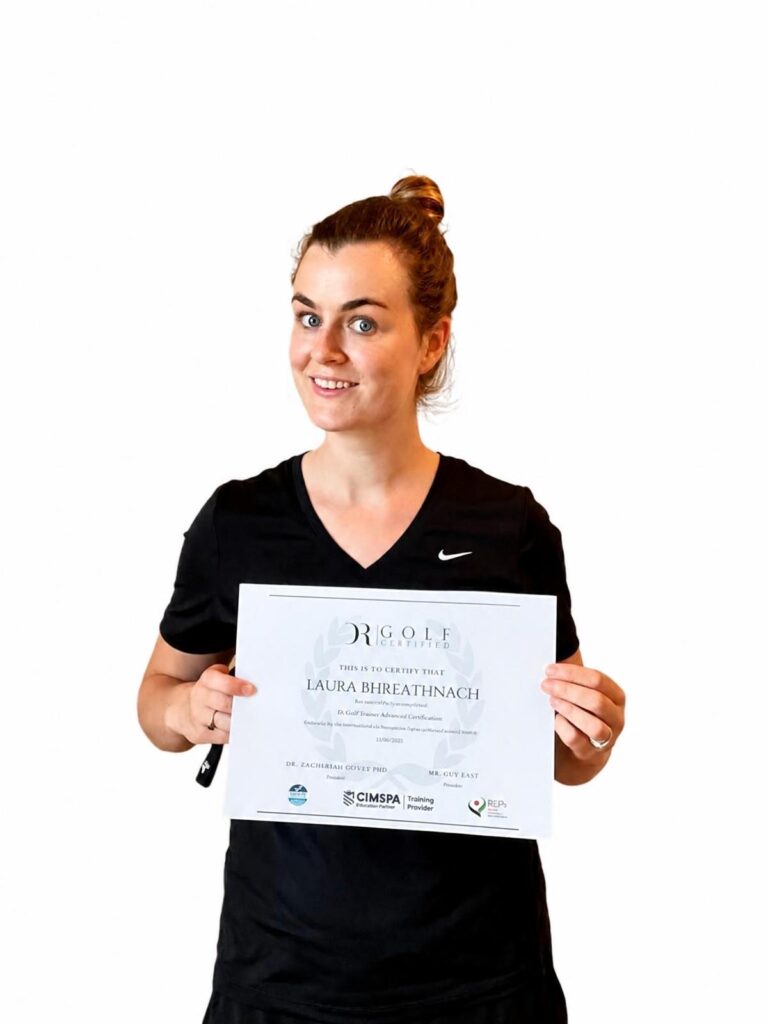
Laura Bhreathnach
Laura is the Managing Director and Senior Chartered Physiotherapist at PREP Physio in Ballsbridge. She holds an MSc in Advanced Physiotherapy from UCD and has over 10 years’ experience in private practice and elite sport, including Scottish Rugby and Scottish Golf.
Book an appointment at PREP Physio
62 Baggot Lane, Ballsbridge, Dublin 4 – Monday to Friday, 7am to 7pm.